

 After years of working with students inside Online Marketing Classroom, I’ve started to notice a consistent pattern.
Most of the people building real momentum are not doing it from a quiet home office with eight uninterrupted hours ahead of them. They’re doing it early in the morning before the rest of the house wakes up. They’re doing it at the kitchen table after dinner. They’re squeezing in an hour during a lunch break, door closed, phone face down.
I spoke with a student recently who works a full-time corporate job, helps care for an aging parent on the weekends, and still finds five focused hours each week to move his business forward. She wasn’t complaining about her schedule or waiting for the “perfect time.” She was simply executing inside the constraints she had.
What’s interesting is that students like her often make faster progress than those who technically have more free time.
That may sound counterintuitive, but it isn’t.
The Paradox of “More Time”
It’s easy to believe that the real bottleneck is time. That if you just had more of it, everything would fall into place.
I’ve tested that theory from both sides.
I’ve built businesses while working full-time, where every spare hour had to be used deliberately. And I’ve built businesses after leaving the 9–5, when entire days were suddenly open in front of me.
What I learned is something most people don’t expect: When time is limited, your decisions tend to improve. You become far more selective about what deserves your attention. When time feels abundant, it’s surprisingly easy to drift into unnecessary complexity. You end up tweaking things that don’t matter, consuming more content than you implement, and mistaking motion for progress.
So here’s the real question: If you only had five hours per week to build your online business and that was non-negotiable…how would you use them?
Here’s exactly how I would.
Hour 1: Build One Income-Producing Asset
If I only had five hours a week, the first hour would be reserved for one thing: building or improving something that is directly tied to revenue or lead generation.
 That might mean writing a single sales email that points to your core offer. It might mean rewriting the headline on your landing page so it’s clearer and more compelling. It could be tightening up your core offer so that someone reading it immediately understands who it’s for and why it matters. Sometimes it’s as simple as strengthening your guarantee or recording a short video that explains the value more clearly.
What it would not include are admin tasks, visual tweaks, or researching the latest tool someone recommended in a Facebook group.
A rule I often use is this: if the work I’m doing right now couldn’t realistically produce revenue or qualified leads within the next 30 days, it doesn’t belong in this hour.
That filter alone eliminates most distractions.
Action step: Before next week begins, decide on one asset — just one — that you will either build or improve. Write it down. Be specific. Then give it your first focused hour.
Hour 2: Distribute What Already Exists
One of the most common patterns I see is this: entrepreneurs spend most of their energy creating, and very little distributing.
They write a strong email, send it once, and move on. They record a useful video, post it to one platform, and assume it has “run its course.” Then a few weeks later they’re frustrated that their content isn’t gaining traction.
The issue usually isn’t quality. It’s exposure.
Content sitting idle doesn’t build a business. The work doesn’t compound until people actually see it.
If I only had five hours, I wouldn’t spend this second hour creating something new. I would take something that already exists and give it more surface area.
That could mean turning a single email into several short social posts. It could mean resharing a piece of content that performed well a few months ago (because the reality is that a large portion of your audience probably never saw it!). It might mean sending fresh traffic to your main offer from a platform where your audience is already active.
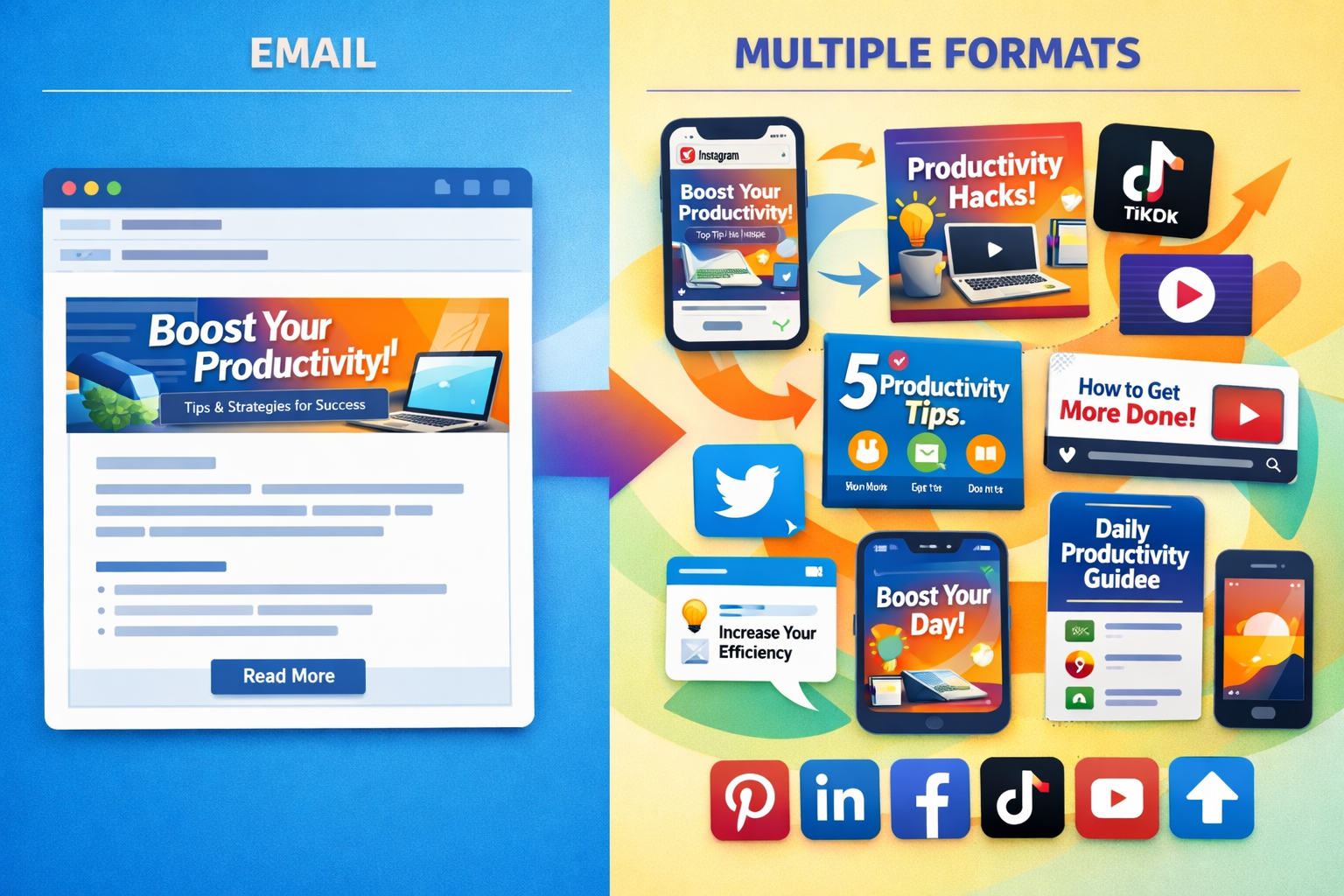 Action step: Choose one piece of content you’ve already created and find a new way to redistribute it this week. Resist the urge to make something new. Focus on getting more mileage from what you’ve already built.
Hour 3: Improve What’s Already Working
One of the most common patterns I see is the constant desire to build something new. Launching another funnel or creating a new product feels like progress because it gives you something tangible to point to. But expansion is not always improvement.
In many cases, refining what already exists produces better results than starting from scratch.
A clearer headline on your landing page can increase opt-ins without any new content. A stronger explanation of who your offer is for can reduce confusion and prevent the wrong buyers from coming in. Even simplifying your checkout process can recover revenue that was quietly slipping away.
 These changes aren’t dramatic, but they compound.
If I only had five hours, I would spend one of them reviewing what potential customers already see and asking a simple question: where is the friction?
If you’re unsure where to begin, start with your homepage headline. It shapes the first impression and influences everything that follows.
Action step: Rewrite one headline this week with greater precision. Even a small improvement here can have an outsized impact.
Hour 4: Build a Real Relationship
The students who grow the fastest tend to share one habit that doesn’t get talked about enough: They make the effort to build real relationships instead of simply broadcasting to an audience.
They reply to emails. They follow up. They ask questions. They treat the people on the other side of the screen as individuals rather than metrics.
If I only had five hours a week, one of them would be dedicated to strengthening those connections.
 That might mean replying personally to five subscribers instead of sending another broadcast. It could mean checking in with a past customer to see how things are going, or asking a few trusted people for honest feedback on your offer. Sometimes it’s as simple as reaching out to someone you respect and starting a conversation.
Trust builds. The relationships you build now often become future referrals, testimonials, partnerships, and repeat customers. Those outcomes rarely show up overnight, but they create stability over time.
Action step: Send one meaningful, personal message today. Not a broadcast. One thoughtful message to one person.
Hour 5: Step Back and Assess
This is the hour most entrepreneurs skip, and in many cases it’s the one that matters most.
When time feels scarce, reflection is often the first thing to disappear. It feels indulgent. It feels unproductive. So people stay in execution mode and assume momentum equals progress.
But activity and direction are not the same thing.
If I only had five hours, I would reserve one of them to step back and assess the bigger picture.
- What is actually producing results right now?
- What feels forced or unnecessarily complicated?
- Where is the real bottleneck in the business?
- If I could double down on one thing this week, what would it be?
 Most entrepreneurs are so deep in doing that they rarely question whether the path itself makes sense. They optimize systems that may not deserve to exist. They refine tactics without revisiting strategy.
Some time spent in honest reflection can often redirect weeks of misplaced effort.
Action step: Block one uninterrupted hour in your calendar this week for review and strategic thinking. Treat it with the same seriousness as you would a client meeting.
What I Would Not Do With Those 5 Hours
I wouldn’t redesign my branding. I wouldn’t learn new software simply because it looked interesting. I wouldn’t start a second project before the first one was working. I wouldn’t build a complex funnel without proof that the core offer resonates. And I wouldn’t spend those hours consuming training unless I was prepared to implement something immediately.
The real danger isn’t a lack of time. It’s the assumption that the important work can always be done later.
A Quick 5-Minute Audit
If you want to pressure-test this idea, try something simple: Write down everything you did in your business over the last seven days. Then circle the activities that directly produced revenue or leads, or clearly moved you closer to doing so.
Now estimate how many hours went to everything else.
Most people are surprised by how much effort is spent maintaining motion rather than building momentum.
Now, choose one low-value activity and remove it this week.
Five focused hours will outperform fifty scattered ones.
The goal isn’t to find more time. It’s to make better decisions inside the time you already have.
Start with one disciplined hour this week and see what changes.

