
Last Tuesday, I watched something fascinating happen in real-time.
I was helping a coaching client optimize her blog content about email marketing for service providers. She’d written this incredibly detailed post answering “What is email marketing?” — complete with definitions, benefits, and examples. It was good. Really good.
Then she showed me her analytics. The post was getting impressions in Google, but almost no clicks. People were finding her content, getting their answer from the AI Overview at the top of the search results, and never visiting her site.
She’d done everything right according to the old playbook. And it didn’t matter.
That’s when it hit me: Search isn’t a lookup anymore. It’s a conversation. And if you’re only answering the first question, you’re getting left behind before the conversation even starts.
Google Gives Away Your Answer (Before Anyone Clicks)
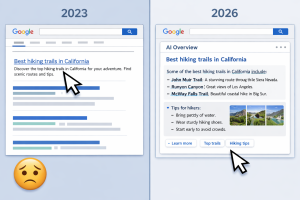 Here’s the uncomfortable truth about search in 2026: Google’s AI Overviews are eating the first-click advantage.
Someone types “What is email marketing?” and Google serves up a neat little summary pulled from various sources. The searcher gets what they need without ever clicking through to your carefully crafted blog post.
This is where most content creators panic. They think the game is over. But it’s not over — the rules just changed.
You don’t win anymore by answering the first question. You win by anticipating what they ask next. Because while AI can serve up surface-level answers, it can’t predict the unique journey someone takes when they’re actually trying to make a decision.
That’s where the Question Ladder comes in.
Every Answer Creates a New Question
The Question Ladder is a simple framework for mapping the natural sequence of questions someone asks before making a decision.
Here’s the core principle: Every answer creates a new question. When someone learns what email marketing is, they immediately wonder if it’s better than social media. When they understand how it works, they want to know if it’ll work for them. When they see it might work, they need to know what mistakes to avoid.
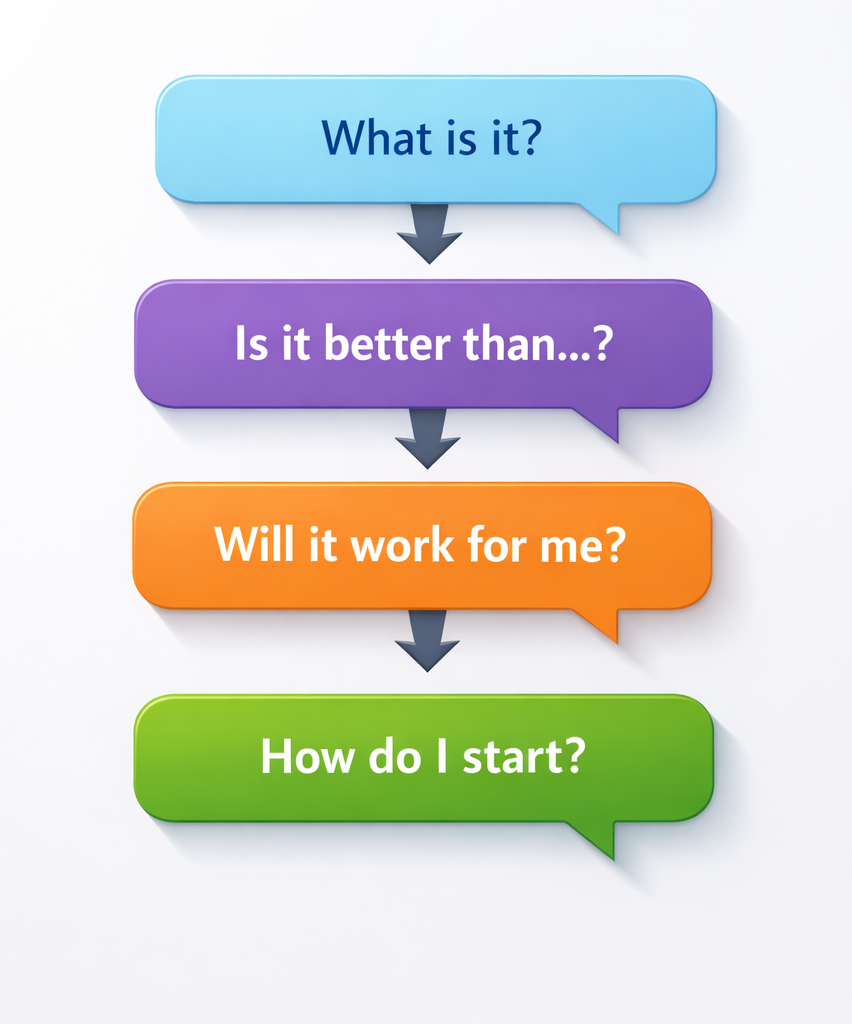 This progression isn’t random. It follows a predictable path: Awareness leads to comparison, comparison leads to decision, and decision leads to action.
The beauty of this approach is that it aligns perfectly with how Google’s conversational search actually works now. The algorithm rewards depth and structured coverage. When you build content that answers not just the first question but the entire conversation, you position yourself as the authoritative source throughout the buyer’s journey.
And here’s the kicker: Your competitors are still optimizing for single keywords while you’re mapping entire conversations.
Four Steps From Random Content to Strategic Conversation
Building your own Question Ladder isn’t complicated. You don’t need fancy tools or complex keyword research. You just need to think like your audience and map their journey.
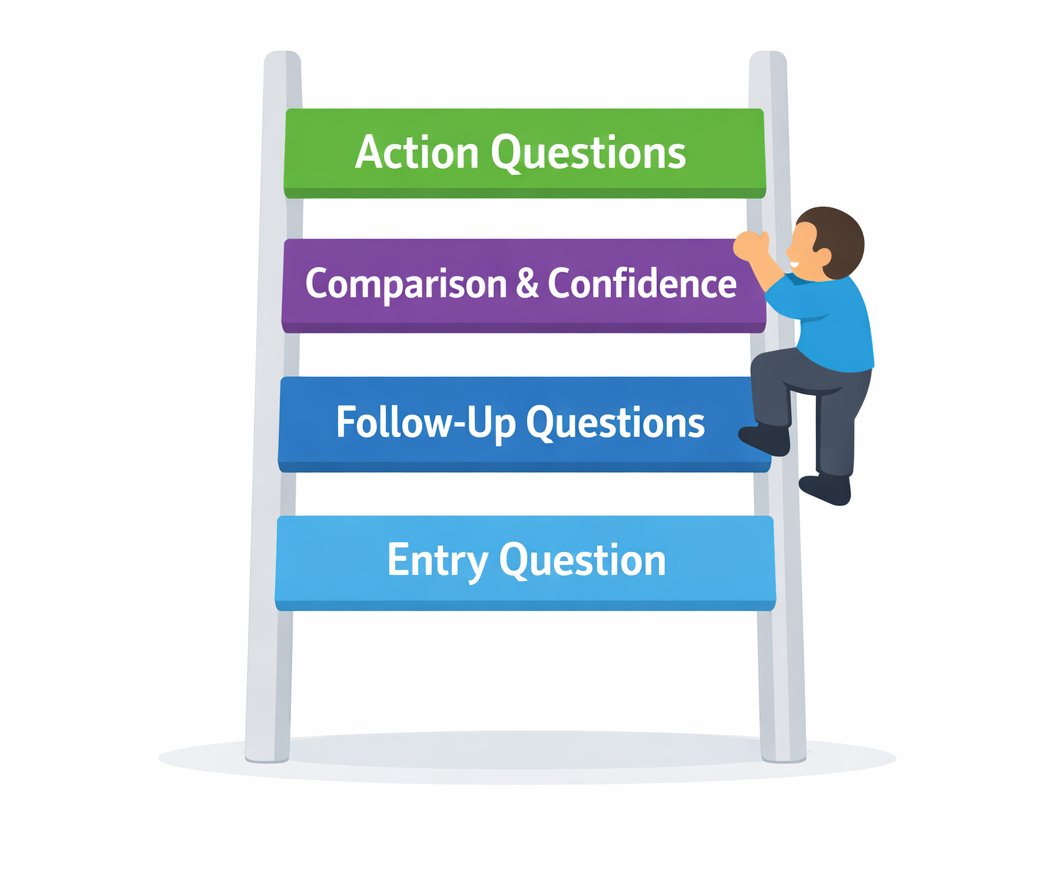 Step 1: Start With the Entry Question
This is the first thing someone types into Google when they’re beginning to explore your topic.
Common formats include “What is X?”, “How does X work?”, and “Is X worth it?” These are awareness-stage questions. People are just getting oriented.
The key here is choosing topics with commercial intent. “What is mindfulness?” is an awareness question, but it’s probably too broad and philosophical. “What is email marketing for coaches?” is an awareness question with clear commercial potential.
Start there. Pick one entry question that real people actually search for and that eventually leads to a purchase decision.
Step 2: Map the Immediate Follow-Ups
After someone understands the basics, what naturally comes next?
This is where you think through the actual conversation you’d have if this person were sitting across from you. If someone asks you what affiliate marketing is and you explain it, their next question is usually something like “Is it better than creating my own products?” or “Does it actually work for beginners?”
These follow-up questions reveal what people really want to know. They’re moving from understanding to evaluation. They’re not just curious anymore — they’re considering whether this is right for them.
Write down three to five questions that would logically follow your entry question. Don’t overthink it. Just ask yourself: “If someone understood the answer to my first question, what would they ask me next?”
Step 3: Add Comparison, Confidence, and Action Questions
Now you’re building the middle and bottom of your ladder. This is where most content strategies fall apart because people stop at awareness-level content.
The comparison layer is where people are actively evaluating options. These questions sound like “X vs Y”, “Best tools for beginners”, or “Budget options vs advanced solutions”. They’re weighing alternatives and trying to figure out what fits their situation.
The confidence layer addresses hesitation and risk. Questions here include “Will this work for me?”, “What mistakes should I avoid?”, and “How long does it actually take?” People need reassurance before they commit.
Finally, the action layer is where you give them the roadmap. “How do I start?”, “What are the exact steps?”, and “What do I need to get going?” These questions tell you someone is ready to move — they just need clear direction.
Each layer builds on the previous one. Each answer naturally creates the next question. And when you map all of this out, you’ve got a complete content strategy that keeps you in the conversation from curiosity to conversion.
Step 4: Structure It Before Publishing
Here’s where people usually mess this up: They create all this content but publish it as random, disconnected blog posts.
Don’t do that. Instead, build a content pathway. Your entry question post should link to your comparison posts. Your comparison posts should link to your confidence-building content. Your confidence content should lead to your action guides.
You’re creating a breadcrumb trail through the buyer’s journey. When someone lands on any piece of your content, they should be able to naturally progress to the next logical question without leaving your site.
This internal linking strategy is powerful for SEO, but more importantly, it’s powerful for conversions. You’re guiding people through their decision-making process instead of hoping they randomly stumble through your content in the right order.
One Topic → 10 Pieces of Content That Work Together
Let me show you how this works with a real example: affiliate marketing for beginners.
Start with the entry questions. You create content for “What is affiliate marketing?” and “How does affiliate marketing work?” These are your awareness pieces. They introduce the concept and explain the mechanics.
Then you move to validation. “Is affiliate marketing still worth it in 2026?” addresses the skepticism and shows current opportunities. “Best affiliate networks for beginners” helps people understand where to actually start.
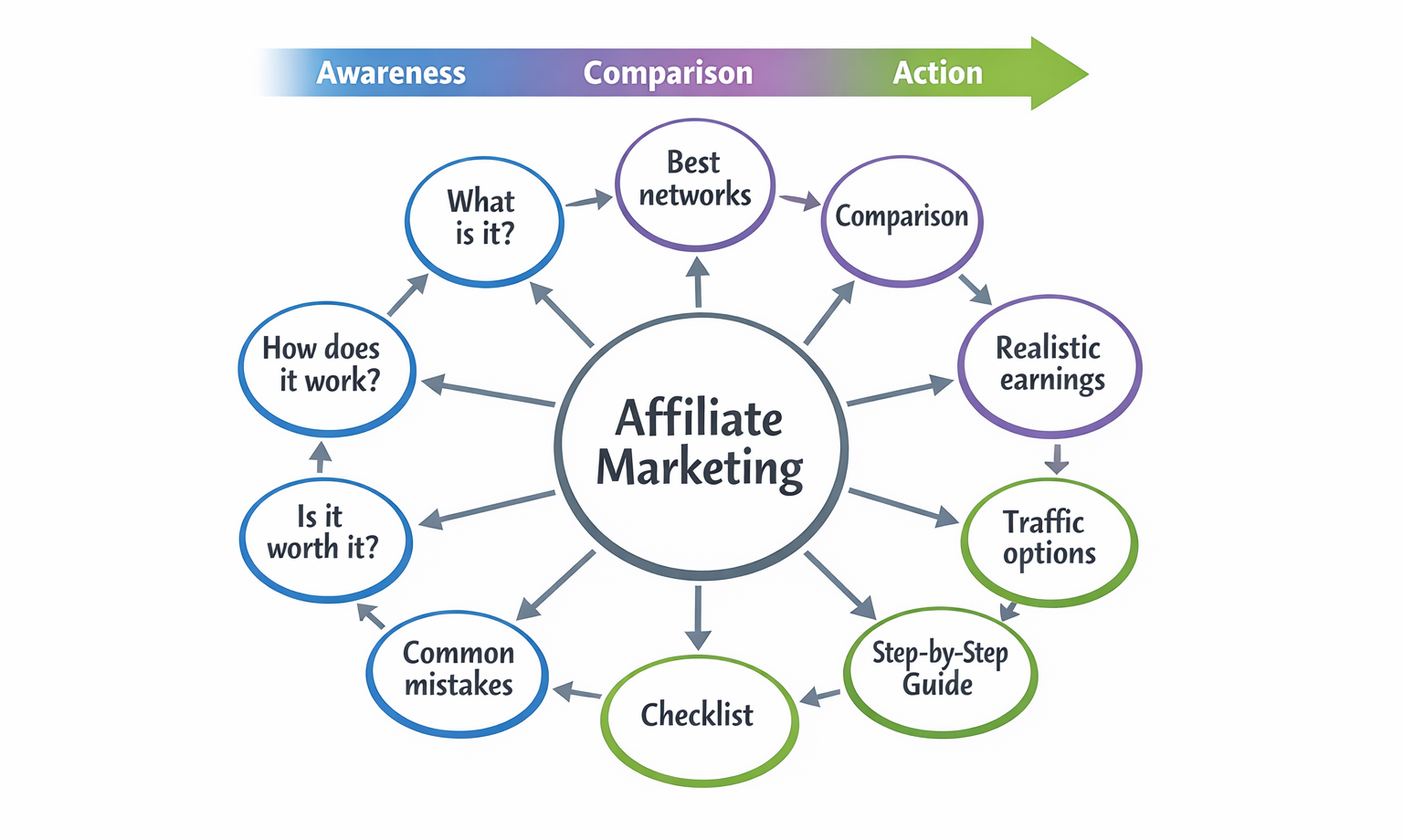
Next comes comparison content. “ClickBank vs ShareASale” helps them choose between popular networks. “Free traffic vs paid traffic” addresses one of the biggest decision points beginners face. These pieces help people narrow their options.
Now add confidence-building content. “How much can you realistically earn with affiliate marketing?” sets proper expectations without hype. “Common beginner mistakes in affiliate marketing” helps them avoid pitfalls and builds your credibility as a guide who understands the journey.
Finally, create action content. “Step-by-step: Launch your first affiliate campaign” gives them the roadmap. “Checklist: Your first affiliate promotion” provides a practical tool they can use immediately.
Notice what happened here? One broad topic — affiliate marketing for beginners — turned into ten interconnected pieces of content. Each piece answers a specific question in the natural progression. Each piece links to the next logical question.
Someone searching for “what is affiliate marketing” might land on your first post, get their answer, and then naturally wonder if it’s still worth it. Click. Then they want to know which network is best. Click. Then they need to understand traffic options. Click.
You’ve just kept them in the conversation through four pieces of content instead of losing them after the first click. That’s the power of the Question Ladder.
Where Most People Get This Wrong
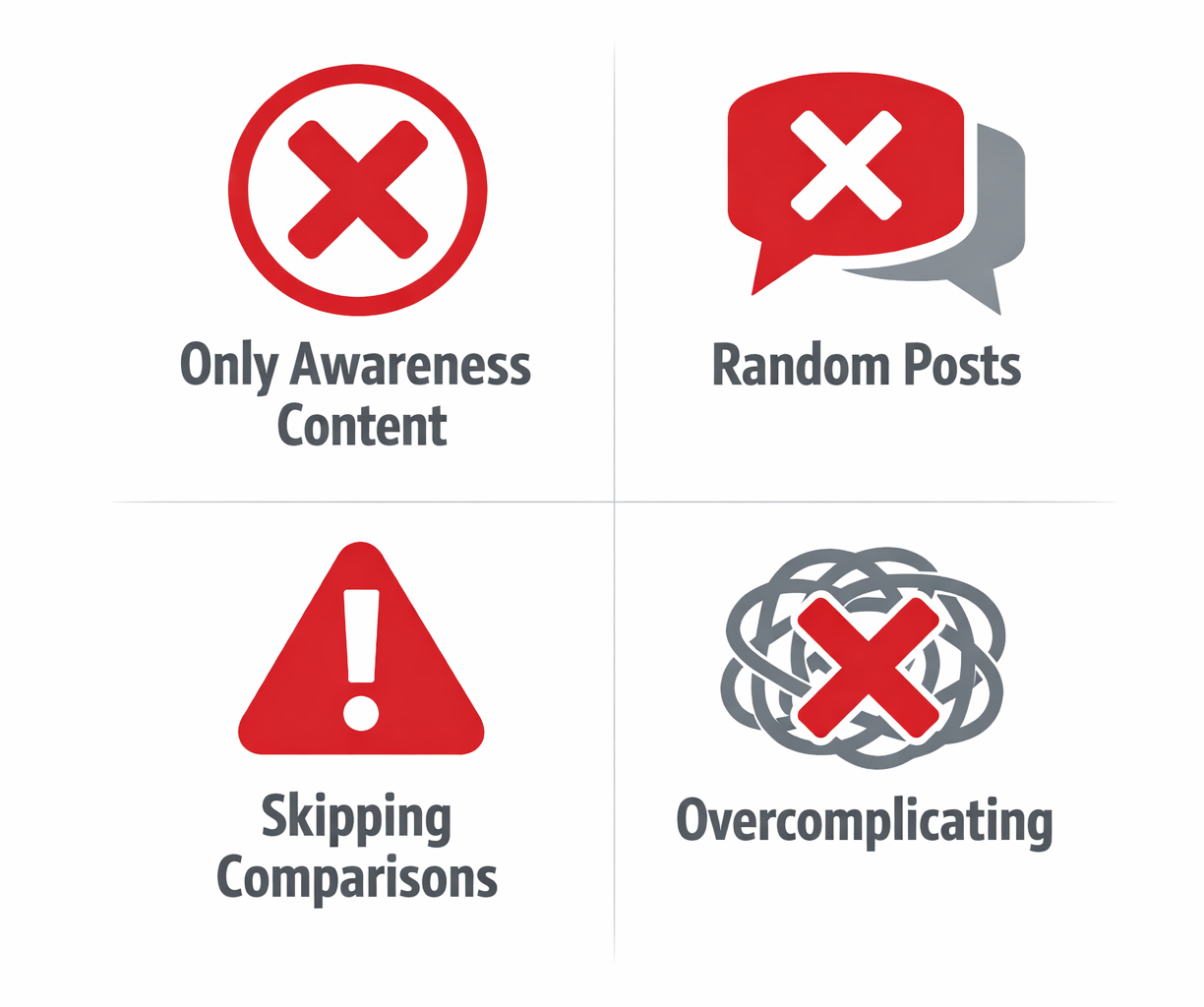 Even when people understand this framework, I see four common mistakes that kill its effectiveness.
The first mistake is only creating awareness-level content. They write ten different versions of “What is X?” targeting slightly different keywords. This completely misses the point. You need depth, not breadth at the surface level.
The second mistake is creating random content without structure. They write about comparison topics one week, action guides the next, and awareness content after that. There’s no pathway. No progression. Just scattered posts that don’t work together.
The third mistake is ignoring the comparison and decision layers. They jump straight from “What is X?” to “How to do X” without helping people evaluate if X is even right for them. You lose people in that gap.
The fourth mistake is overcomplicating the framework. They try to create a thirty-piece content series mapping every possible question. Keep it simple. Ten to fifteen well-structured pieces will outperform fifty random posts every time.
Stay in the Conversation
Search is layered and conversational now. The old strategy of targeting individual keywords and hoping for clicks doesn’t work like it used to.
But here’s the opportunity: Most of your competitors are still operating under the old rules. They’re still writing isolated blog posts targeting single keywords. They’re still wondering why their traffic is dropping.
You can build something better. You can map the entire conversation your ideal customer has with themselves before they buy. You can create content that answers the next question before it’s asked.
The Question Ladder isn’t just an SEO strategy. It’s a positioning strategy. It’s a conversion strategy. When you guide people through their decision-making journey instead of just answering their first question, you become the obvious choice when they’re ready to take action.
Start with one topic. Map the questions. Build the pathway. And watch what happens when you stop fighting for the first click and start winning the entire conversation.
Ready to build these content pathways faster? LaunchPad Pro makes it simple to create high-converting landing pages and blog content in minutes, not hours. Try it free for 14 days and see how easy it is to turn your Question Ladder into real, published content.

