
I watched one of our students post a 22-second Reel about choosing affiliate offers last month. It was nothing fancy. She talked straight to the camera, shared one filter she uses before promoting anything, and moved on. That video pulled more saves and comments than anything she had posted in three months.
 And then she did what almost everyone does. She moved on to a completely new topic the next day, then another new topic the day after that, and by Friday she was staring at a blank screen wondering what to post next. The video that actually worked? Already buried in her feed. Never referenced again.
I’ve watched this happen with hundreds of students, and it always follows the same pattern. Someone creates a piece of content that clearly resonates, the audience tells them it’s good through engagement, and then the creator just… moves on. The one thing that worked becomes the one thing they never use again.
Why “Always Be Creating” Feels Right But Usually Isn’t
I get the instinct. Every platform rewards consistency, and every piece of advice you read says to post every day. So the natural conclusion is that you need a new idea every single day, which means constantly brainstorming, constantly scripting, constantly filming. That sounds like discipline, and it feels productive.
But here’s what actually happens. You spend so much energy generating new ideas that you never invest deeply in the ones that already proved themselves. The content that performs best is almost never the thing you spent the most time on. It’s usually a quick, clear video that hit a nerve because it addressed something real. And instead of building on that momentum, most people abandon it and go hunting for the next idea.
 The real cost of the content treadmill isn’t bad content. It’s burnout. Creative fatigue is the number one reason I see students stop publishing altogether, and it almost always comes from this belief that every day requires something brand new. It doesn’t. What it requires is a system for getting more out of what’s already working.
The One-Video Week
The concept is straightforward. You take one short video that already proved it resonates with your audience, and you use it as the seed for an entire week of affiliate content across every format you publish in. Instead of creating seven unrelated pieces from scratch, you create seven connected pieces from one proven idea.
 This works because your winning video has already solved the three hardest problems in content creation for you. It found a hook that stops people mid-scroll, it landed on a topic your audience cares about a then it delivered the idea at an angle that made people pay attention. Those three elements are what make content work, and your audience just handed them to you for free.
Step 1: Find Your Winner
Open whatever platform you post short-form video on, whether that’s Instagram Reels, TikTok, or YouTube Shorts, and look at the last 30 days of posts. You’re looking for the one video that outperformed your average, but not by views alone. Sort by engagement signals that actually mean something: saves, comments, and shares. Views can be inflated by the algorithm for all kinds of reasons, but when someone saves a video or shares it with a friend, that tells you the idea genuinely landed.
If your numbers are small, that’s fine. You’re looking for relative performance, not viral numbers. A video with 12 saves when your average is 2 is a clear signal, even if the view count was modest.
Step 2: Extract the Core Idea
Once you’ve identified your winner, strip it down to one sentence. What was the single insight or idea that made people stop and engage? This becomes your seed for the entire week.
For example, if your winning video was “3 signs an affiliate offer will actually convert,” your seed sentence might be “how to evaluate affiliate offers before spending time promoting them.” If your video was about a specific tool that saves time, the seed might be “the case for using the right tool instead of doing it manually.” The seed isn’t a title or a headline. It’s the underlying idea that made the content useful, and that idea can be expressed in many different formats without ever feeling repetitive.
Step 3: Multiply Into Seven Pieces
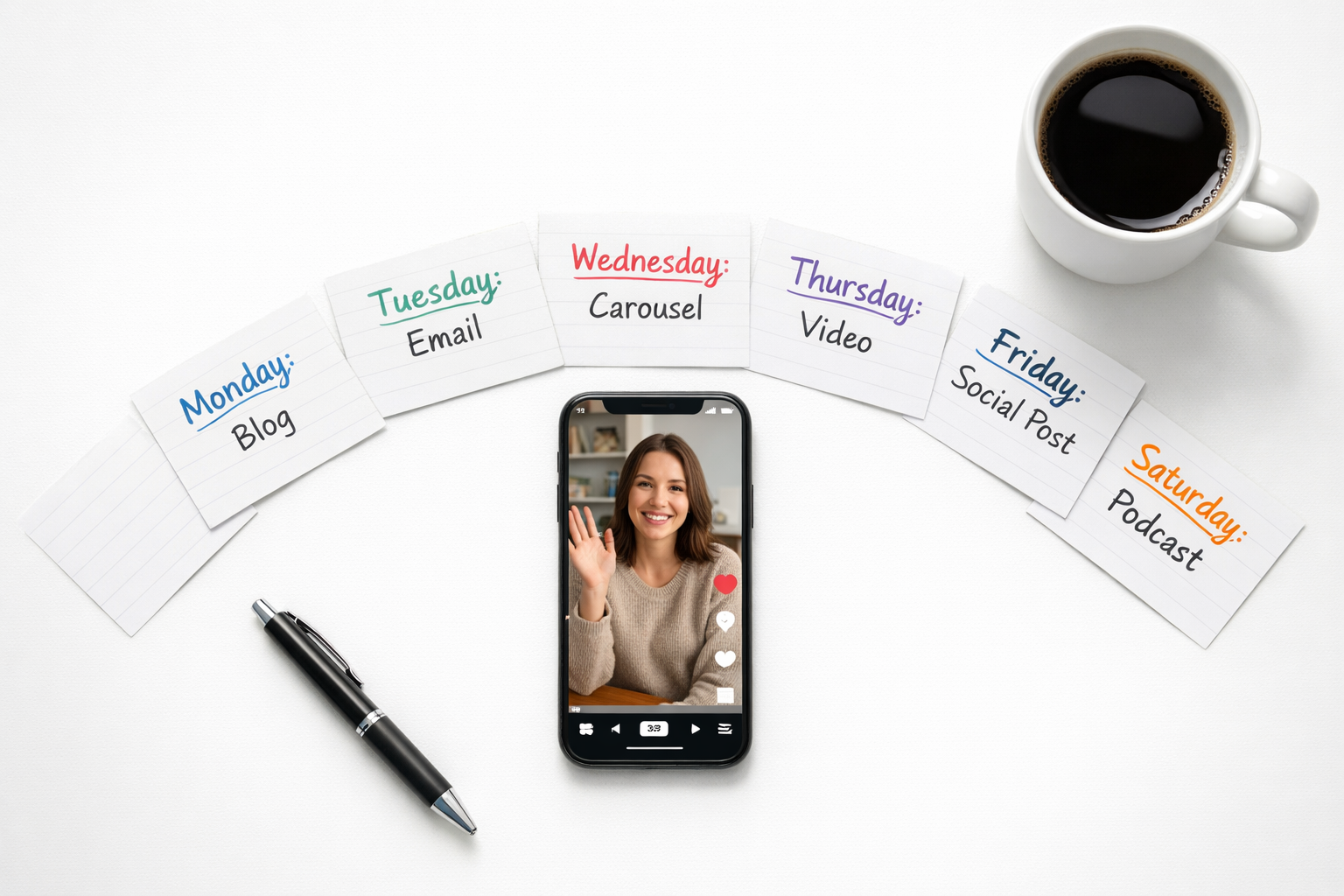
Here’s where the system earns its keep. You take that one seed and expand it across the week, with each piece serving a different format and reaching a different slice of your audience.
- Monday: Publish a blog post that takes the video’s core idea and turns it into a full walkthrough. This is where your affiliate links fit most naturally, because you have the space to explain why you recommend something and show how it works.
- Tuesday: Send an email to your list that uses the same hook from the original video but links to the blog post instead.
- Wednesday: Create a carousel or static image post pulling out three key points from the blog version.
- Thursday: Film a quick follow-up video that acts as a “Part 2” or covers the angle you didn’t get to in the original.
- Friday: Send a second email to anyone who didn’t open the first, using a different subject line and a different angle from the same seed.
- Saturday: Create a simple text or quote-style post with the single best line from any of the week’s content.
- Sunday: Reshare the original winning video with a fresh caption that ties it to the rest of the week’s material.
Seven pieces. One idea. And the only truly “new” content you created was the Thursday follow-up video and the blog post, both of which wrote themselves because you already knew exactly what to say.
Step 4: Link It All Back
Every piece in the One-Video Week should point somewhere, whether that’s to the blog post, to a landing page, or directly to the affiliate offer. The key distinction here is that you’re not creating seven sales pitches. You’re creating seven touchpoints around one idea that your audience already told you they care about, and the affiliate offer is simply the natural next step for anyone who wants to go deeper.
This is why it works so well for affiliate marketing specifically. You’re not forcing a product into unrelated content. You’re building a week of useful content around a topic that naturally connects to something you recommend.
Three Real-World Scenarios
 Scenario one: fitness niche. A student had a 15-second TikTok about protein timing that pulled four times her usual saves. She turned the core idea into a blog post reviewing her top protein supplement affiliate offer, built a carousel for Instagram highlighting three takeaways, and sent two emails linking back to the post. One video became one full week of content, all pointing to the same offer.
Scenario two: personal finance. A Reel about “the one app I actually use to budget” became a comparison blog post with three affiliate links for budgeting tools, a Story Q&A answering follower questions about the app, and a reshare of the original Reel the following Sunday with a fresh caption. The blog post still generates affiliate clicks months later because the content was substantial enough to rank.
Scenario three: digital marketing. A short video explaining “why most landing pages leak money” became a blog post recommending a page builder with an affiliate link, a newsletter mention in the “quick wins” section, and a follow-up video showing a before-and-after fix. The student told me that week felt like the least amount of creative effort for the most affiliate revenue he’d generated in a single week.
Why This Matters
The deeper principle here is one I come back to constantly: your best content ideas have already been validated by your audience. Repurposing is not lazy. It’s strategic. Most people never see your content the first time you post it, so expressing the same idea in a different format reaches entirely new people while reinforcing the message for those who did see the original.
And this protects the two resources that actually determine whether you’re still building your business six months from now, which are your time and your energy. If you can get a full week of content from one proven idea instead of grinding out seven disconnected posts, you stay consistent without burning out. That’s the whole game.
Your 5-Minute Quick Win
 Open your short-form video platform right now and sort your posts by engagement over the last 30 days.
Screenshot your top performer. Then open a note on your phone and write one sentence answering this question: “What was the core idea that made this video work?”
That sentence is your seed. Next week, use it to build your entire content calendar.
“But What If…”
“What if none of my videos have performed well?”
Pick the one that did least badly. You’re looking for relative winners, not viral hits. Even modest engagement signals tell you which idea resonated more than the others, and that’s enough to build on.
“What if I don’t have affiliate offers that match my video topic?”
The seed idea is your bridge. Almost any proven topic can connect to a relevant offer if you think about what the audience would need next. Search affiliate networks for the keyword in your seed sentence, and you’ll almost always find something that fits naturally.
“Won’t my audience get bored seeing the same idea all week?”
They won’t, because each format reaches different people at different times. Your email subscribers may never see your Instagram posts. Your blog readers may not watch your Stories. And even the people who do see multiple pieces will experience the idea differently each time, which is how trust and familiarity are built.
 The content treadmill convinces people that more ideas equals more results, but that’s almost never true. What actually drives results is depth, repetition across formats, and a system that lets you stay consistent without draining yourself dry.
One video. One week. One offer. That’s not a shortcut. It’s a system.

