
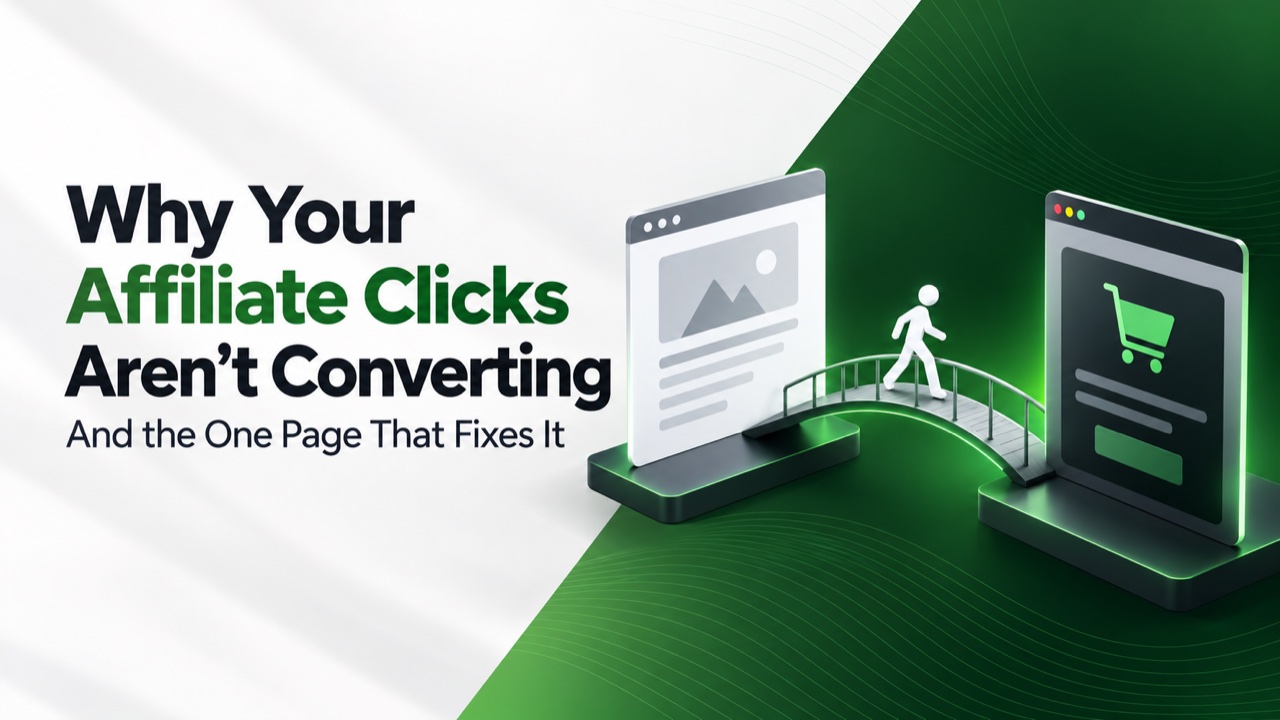
You’ve already done the hard part.
You recommended something you actually rate. Someone read it, trusted you, and clicked your link. And then they landed on the merchant’s sales page.
A page that has never met them. It doesn’t know what you just said, it doesn’t know why they came, and it starts its pitch from zero. Most people read a few lines, feel nothing, and leave.

That quiet gap between the click and the sale is where a lot of affiliate income leaks away. Plenty of things can cost you the sale: the offer, the price, the timing, the merchant’s own page. But one of the most common and most fixable is this. You handed a warm reader straight to a page built to close a stranger, not to continue the conversation you already started.
The fix here isn’t more traffic. It’s one short page that sits in between.
This applies almost everywhere you promote as an affiliate:
- Regular affiliate promotions. Amazon, ClickBank, a SaaS tool, a course you’re an affiliate for.
- Email and content funnels. Sending your list or your blog readers off to an offer.
- Paid-traffic affiliate marketing. Running ads to an offer (with one important caveat I’ll come back to).
By the end of this post you’ll have
- The four-part page mapped out, so you know exactly what goes on it
- The honest math behind the lift, drop-off included, so you can judge it for yourself
- A five-line fill-in-the-blank skeleton you can complete today
- A genuinely free tool to build it on, no website required
The Math, With the Drop-Off Included
Let me show you the numbers, drop-off and all, because “one page doubles your sales” sounds like every other thing you’ve been sold, and I’d rather you see the mechanism than trust the slogan.
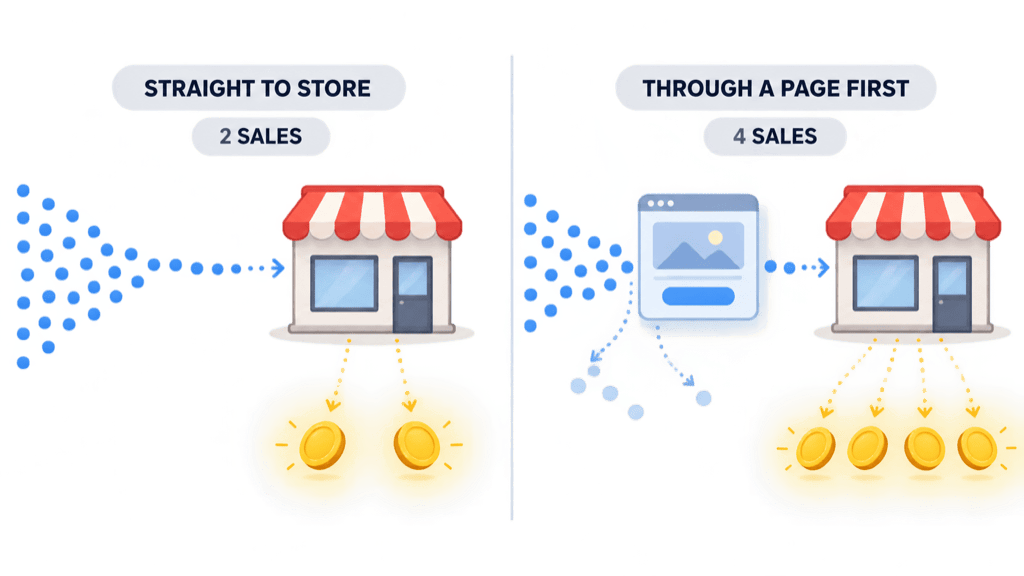
Say 100 people click your affiliate link.
Straight to the merchant. Cold traffic lands on a sales page that has to convince a stranger from scratch. Merchant pages convert cold clicks at low single digits. Say 2%. That’s 2 sales.
Through a short page first. Adding a page also adds a place to lose people, so you won’t get all 100 through. Say 20 drop off at your page, and 80 continue. But those 80 arrive warm, already told what this is and why it fits them, so the merchant page converts them higher. Say 5%. That’s 4 sales.
Same 100 clicks. Double the sales, even after losing a fifth of them at the page. If each sale pays $30 in commission, that’s the difference between $60 and $120 on traffic you already had.
Those percentages are illustrative, not a promise. Some offers will lift more, some will barely move, and a badly written page can do worse than direct linking. So don’t take my word or the example. Run it both ways and measure sales per 100 clicks (or better, revenue per 100 clicks) against sending them direct. The page earns its place or it doesn’t, and the number tells you which.
The One-Page Fix
The page in between is a bridge page. One short page, on your own domain, that catches the click, warms the reader up, and passes them to the merchant already wanting the offer.
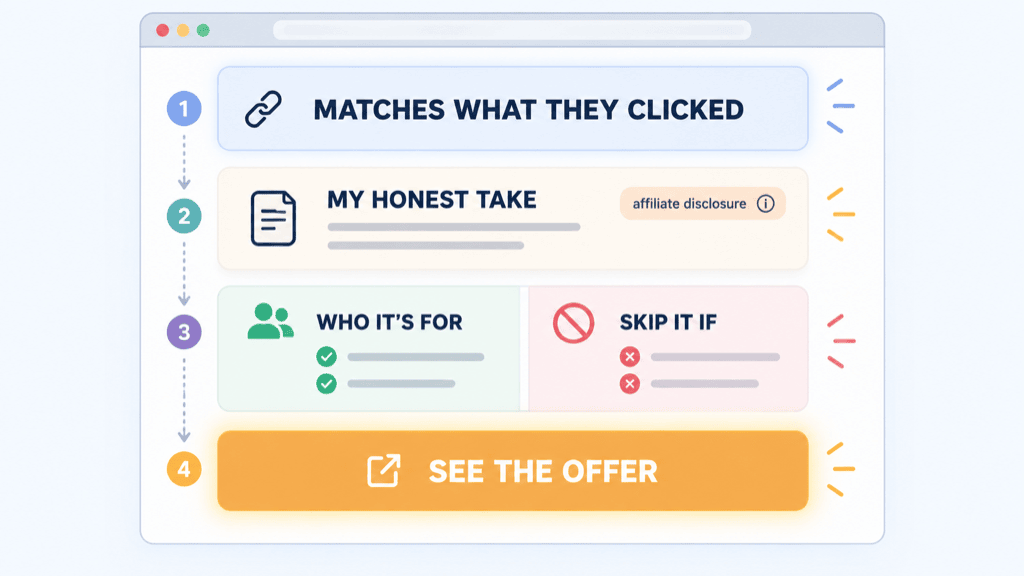
You build it from a reusable template, but you write it fresh for each offer. The template repeats. The words on the page are specific to the thing you’re recommending. Four parts do the work.
Part 1: Match the Page to the Exact Promise They Clicked
Whatever made them click is the thought in their head when they land. Your headline and first line have to continue that exact thought, not restart it.
If they clicked “the tool I use to find winning products,” the page opens on that tool and that job. When the page picks up mid-conversation, the reader relaxes and keeps going. Make them start over and they bounce, the same way a cold merchant page loses them, so don’t recreate that problem on your own page.
Part 2: Give Your Honest Take, and Disclose the Link Right There
This is the pre-sell, and it’s the reason the whole thing works. A few plain lines:
- What the offer actually is, in one sentence
- What you genuinely think of it, including a limitation
- The one problem it solves for this reader
The limitation matters more than the praise. Naming one thing it doesn’t do is what makes the rest believable, because nobody trusts a recommendation with no downside.
This is also where your affiliate disclosure goes, right next to the recommendation, in plain words: “If you buy through my link I may earn a commission, at no extra cost to you.” That’s not legal decoration. The FTC wants the relationship disclosed clearly and close to the link, and programs like Amazon require their own wording. Treat the disclosure as a required part of the page, not an optional add-on. It also doesn’t cancel the disclosure you need wherever the original recommendation appears, so if the email or article that sent them here endorses the offer, disclose it there too, close to that link.
Part 3: Name Who It’s For and Who It Isn’t
A short “this is for you if” and “skip this if” does two jobs at once. It waves off the wrong buyer before they click through and bounce, and it makes the right buyer feel understood, like you were talking to them specifically.
Disqualifying people feels backwards when you want sales. It isn’t. Sending the wrong person through just burns a click, drags down your conversion rate, and can mean a refund later, none of which does you any good.
Part 4: Hand Off the Link With Expectations Set
One clear button, and a line telling them exactly what happens next. What page they’ll land on, roughly what it costs, and any bonus you’re adding.
A reader who knows what’s coming clicks through with confidence. Dump someone onto a surprise checkout and they hesitate, and a hesitating reader usually doesn’t buy.
Three Ways This Plays Out

Scenario one: the review blog. You’ve got an article comparing three standing desks with Amazon links. Instead of linking straight to the product, each link goes to a short page: who this desk is right for, the one thing you’d change about it, and what they’ll see on Amazon. Same readers, warmer arrival.
Scenario two: the email list. You’re promoting a SaaS tool to your subscribers. The email sends them to one page that frames the problem the tool solves and your honest take, then hands off to the free trial. The subscribers who click the trial already know why they’re there.
Scenario three: paid traffic. Here’s the caveat I promised. You can run ads to a page like this, but ad networks like Google reject thin pages whose only job is to redirect somewhere else. So this only works if your page adds real value of its own, genuine information the visitor came for, not just a signpost. Check the specific network’s rules before you spend a cent, because a bridge page does not make you compliant. A genuinely useful page might.
Why This Matters

You spend most of your energy getting the click. The article, the email, the ad, the trust you’ve built over months. All of that work exists to earn the moment someone clicks your link, so it’s worth controlling what happens in the seconds right after it.
A bridge page won’t rescue a bad offer or the wrong audience. If your traffic is cold, the price is off, or the product just isn’t a fit, fix that first, because no warm-up page saves an offer people don’t want. But when the offer is right and people still slip away at the merchant’s door, a page that greets them in your voice is one of the cheapest fixes you have, since it works on traffic you already paid for in time and trust.
Your 5-Minute Quick Win
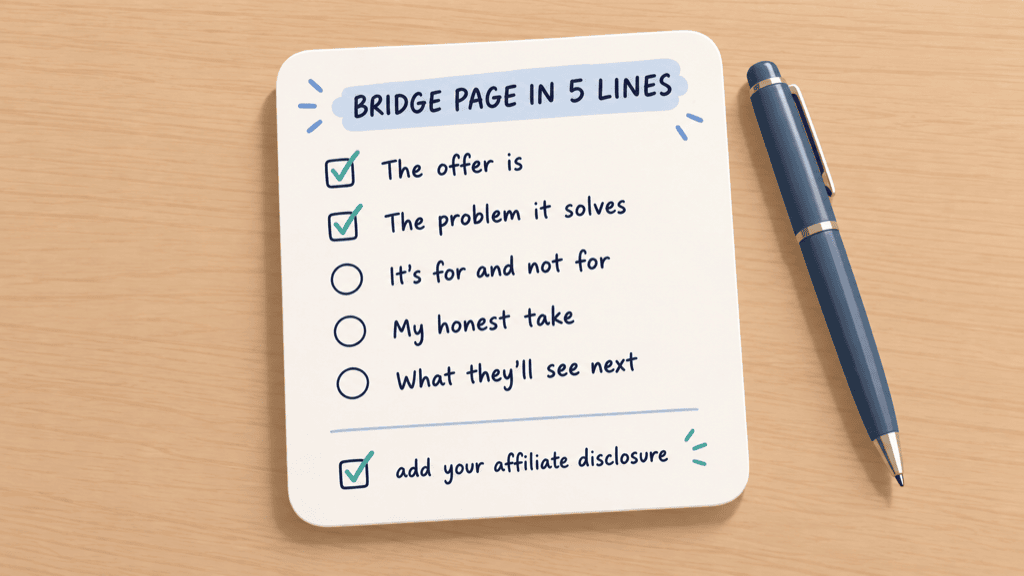
Pick one offer you’re promoting right now and fill in these five lines in a note:
- The offer is: ___
- The one problem it solves is: ___
- It’s for ___ but not for ___
- My honest one-line take (with one limitation) is: ___
- When they click, they’ll see: ___
That’s your bridge page mapped. When you build it, add the plain disclosure line from Part 2. Five lines now, a live page this week.
“But What If…”
“What if I don’t have a website?”
You don’t need one. A free single-page tool like Carrd, or a free Google Sites page, is enough to host a bridge page. One page, one link out, live in an afternoon.
“What if adding a step just loses some clicks?”
It will, and that’s fine. The drop-off is built into the math above. The question isn’t whether you lose a few clicks at the page, it’s whether the warmer clicks that continue net you more sales than direct linking did. Sometimes they will, sometimes they won’t, so you test it and let the number decide.
“What if the merchant’s page is already good?”
It probably is, at closing anyone. What it can’t do is speak to your specific reader in your voice about the exact problem that made them click. That pre-sell is the one thing you can do that the merchant can’t, and it’s the whole point of the page.
None of this asks you to find more readers, write more content, or run more ads. The people are already clicking. You’re just giving them somewhere to land that speaks to them first, instead of dropping them cold onto a page that treats them like a stranger.
Get the click you already earn to land somewhere warm, and the same traffic can quietly start doing more work.

