

Black Friday falls on Friday November 27 this year, and Cyber Monday closes the weekend on November 30.
From today, that’s 112 days.
That sounds like plenty of time and it’s why most sellers spend August doing nothing about it and start scrambling somewhere around the middle of October.
The trouble with scrambling in October is that October charges you for it. Ad auctions are crowded with everyone else’s holiday budget, suppliers are quoting longer lead times because every other seller finally placed their order, and a list that hasn’t heard from you since June can’t be warmed up in three weeks.
Then Black Friday arrives, the numbers come in soft, and the conclusion is almost always the same: the offer wasn’t good enough.
Usually it isn’t the offer. It’s one specific thing missing behind it, and you can find out which one in about twenty minutes.
(One thing before you start. This audit assumes you already have an offer that has sold before, because readiness only matters for something people already buy. If yours has never produced a sale, validating it comes before all four checks.)
By the end of this post you’ll have:
- A pass or fail on each of the four things a Q4 push runs on
- One named bottleneck instead of a to-do list of twelve
- The specific August fix for that bottleneck, and what it realistically costs
- A dated checkpoint so you know in September and October whether you’re on track
The Q4 Bottleneck Audit
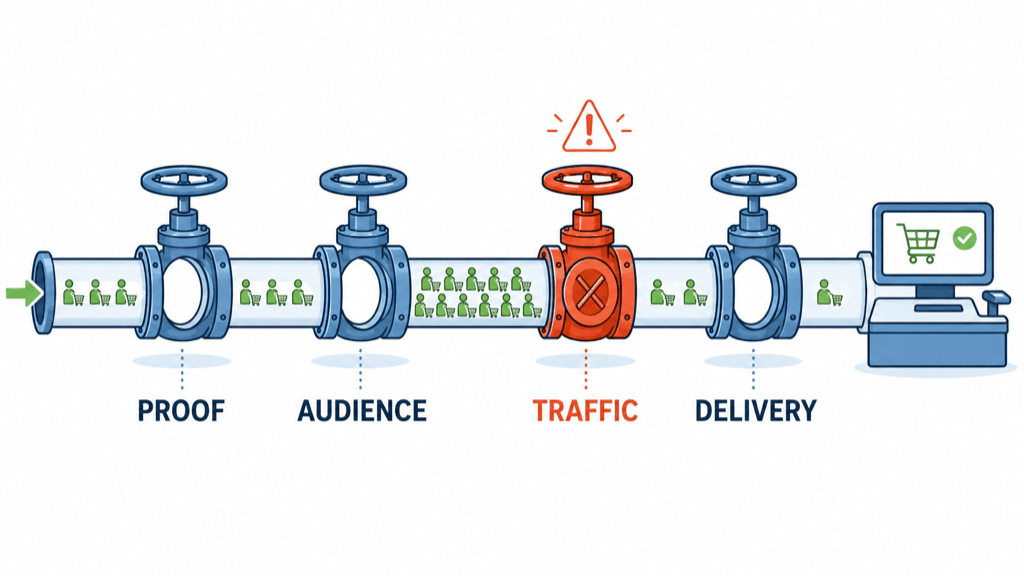
Four checks, five minutes each, and each one has a clear fail line so you finish with a verdict rather than a vague feeling that you should probably do more.
It’s built this way because Q4 advice is almost always written for one imaginary seller. A store owner with no reviews and a dropshipper whose supplier can’t deliver before Christmas need completely different Augusts, and generic advice hands them the same homework.
Fair warning on the numbers below. They’re working rules of thumb, not findings from a study, so your situation might justify moving them a little as long as you’re honest about which side of the line you’re on.
Grab your one hero offer, the single product or promotion you plan to push hardest in November, and run it through all four.
Check 1: Does Your Hero Offer Have Proof a Stranger Would Believe?
Look at your offer the way someone who has never heard of you would, and ask what’s there telling them it’s worth buying.

- If you own the product page: the check fails if you have neither 10 recent, product-specific reviews nor another credible form of proof, such as buyer photos, a demonstration video, or clear before-and-after results.
- If you’re an affiliate and don’t control the reviews: your content is the proof. The check fails if it contains no firsthand evidence, no comparison against the alternatives, no demonstration, and nothing from the merchant you can point to.
Ten reviews on their own don’t get you a pass. Ten vague ones from two years ago, or ten about your shipping speed rather than the product, won’t reassure anyone deciding between you and a listing with 400 ratings.
What a fail costs you in November: cold Black Friday traffic is the least trusting traffic you’ll ever get, and it has no reason to pick you over the option that looks safer.
Check 2: Can Your Existing Audience Send You Meaningful Traffic?
Open your last three email sends, or your last three posts if email isn’t your channel, and look at clicks rather than opens. Apple loads remote images whether or not anyone reads the email, so opens tell you very little, and clicks are the more useful signal (even though automated security scanners can inflate those too).

This check is about volume as much as warmth. A list of 100 people producing 20 clicks is a genuinely warm audience, but it still can’t carry a Q4 push on its own.
- Fail line: none of your last three sends generated at least 25 unique clicks, or you haven’t sent anything in 60 days.
What a fail costs you in November: the sellers who do well on Black Friday weekend can reach buyers for free on the day itself, and everyone else pays for every single visitor.
Check 3: Have You Tested the Route Your November Traffic Will Take?
Name the traffic source you intend to use and the angle you’ll lead with, then check whether you’ve ever run it. You’re testing the route and the angle, not your finished holiday creative, because nobody has their November assets built in August and waiting until you do is how the test never happens.
- Fail line: you haven’t sent at least 25 qualified visitors from your intended traffic source to this offer, or a closely related version of it, and looked at what they did next.
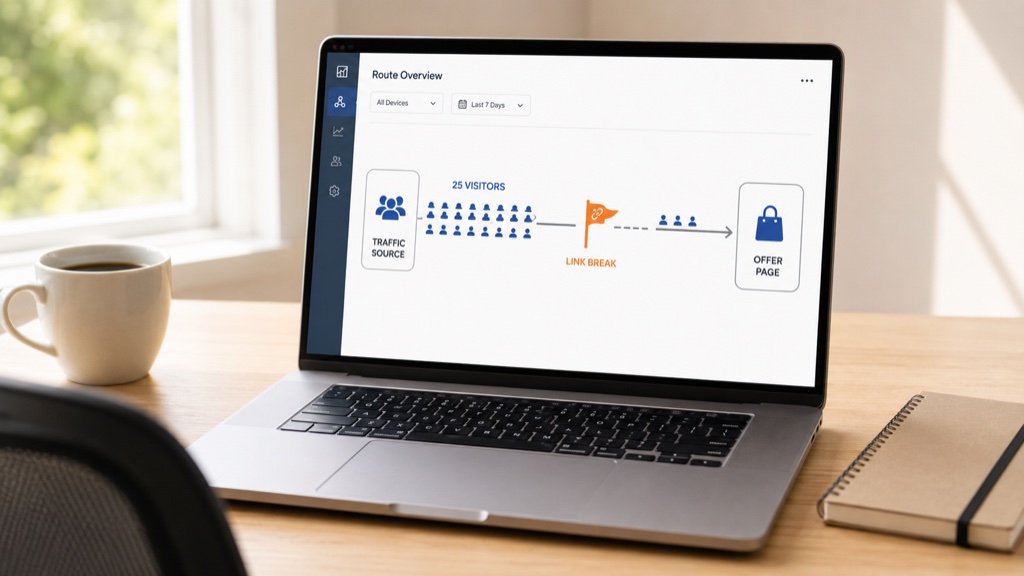
By qualified, I mean people who arrived because of the targeting or the topic you’ll use in November, not 25 random clicks from a post that happened to travel. If you can’t say what the visitor was looking for when they clicked, they don’t count.
Twenty-five is a small number on purpose. It won’t tell you whether the source will be profitable. It will tell you whether the route and the tracking work, whether the traffic looks relevant, and whether anything breaks between the click and the offer.
What a fail costs you in November: you run your first real test during the most expensive weeks of the advertising year, paying peak prices to learn what August would have taught you cheaply.
Check 4: Can You Deliver, and Will the Offer Still Be There?
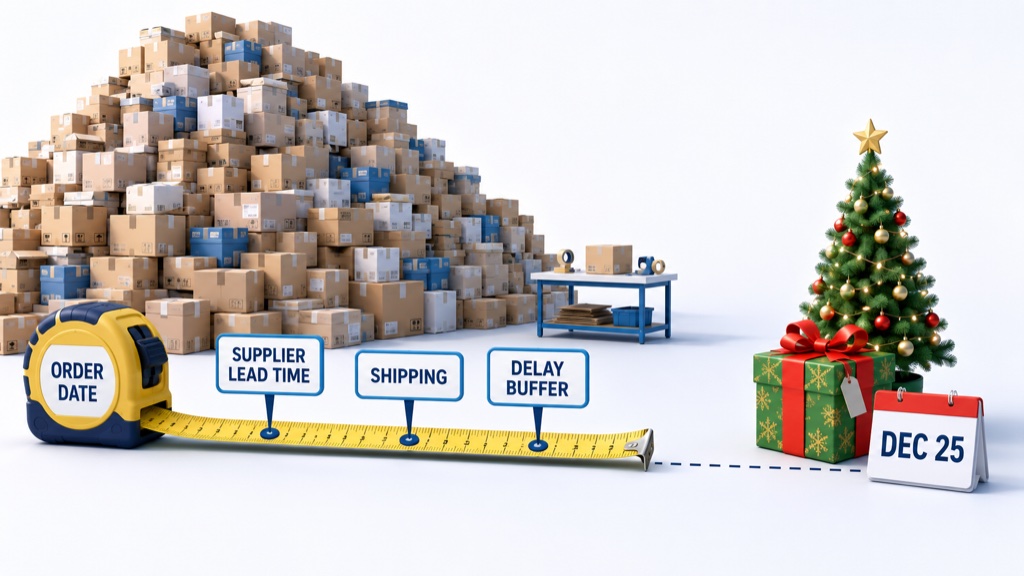
There’s no universal cutoff date here, because a deadline that’s fine for a household item is far too late for a Christmas gift. Work backwards from the customer instead.
If you sell physical products:
- Decide the arrival date your customer expects. A gift needs to land comfortably before December 25, while a non-gift purchase has more slack.
- Subtract shipping time, supplier lead time, and your own processing.
- Subtract a delay buffer, because December delays are normal rather than exceptional.
The check fails if that math puts your order date in the past, if it lands after a date you’ve already promised on your site, or if any number in the chain is an unsupported guess rather than a current supplier commitment, a carrier estimate, or a processing time taken from your own records.
Then check volume, because dates that work for one order tell you nothing about a spike. How many units can your supplier provide at that lead time, and how many orders can you realistically pack, ship, and support during your busiest week? The check fails if the dates hold for one order but not for the number you’re hoping to sell.
If you’re an affiliate, the equivalent is offer readiness: approval confirmed, commission rate and cookie window checked, and some idea of whether the merchant is planning a site-wide November discount that undercuts the angle you were going to use. The check fails if any of that is unconfirmed.
Your Verdict: Fix One, Not Four
Most people fail more than one check, which is normal. What matters is which one you work on, so use this order:
-
If Check 4 failed in a way that could make your offer undeliverable or unavailable, fix that first. No amount of reviews will rescue a product that arrives on December 28. It’s a hard stop, so it jumps the queue.
-
Otherwise, work down the list in order and fix the lowest-numbered check you failed, so Check 1 before Check 2 and Check 2 before Check 3. The order isn’t arbitrary, because proof is what makes your audience click and traffic is wasted on an offer nobody trusts.
-
Then leave the rest alone until September. August has about four usable weeks in it, and one bottleneck genuinely fixed beats four half-started every time.
Your August Fix, Depending on What Failed
If you failed Proof. Say you’ve got a solid product, traffic that’s fine, and three reviews, the newest from March. Your August isn’t for finding a better product, it’s for building the evidence: email past buyers with a direct request, add real buyer photos to the page, record a short demonstration yourself, and if the item is inexpensive, get a few units into the hands of people who’ll report back honestly. Cost is mostly time. Done by August 31.
If you failed Audience Reach. Say you’re an affiliate with steady search traffic and no list, so November visitors read one page and leave forever. Your August is one capture point on your highest-traffic page with a genuinely useful reason to join, then a regular send so subscribers know who you are before you ask them for anything. Cost is an afternoon of setup and one email a week. Done by August 31.
If you failed Tested Traffic. Say you plan to run ads in November but have never run that source to that offer. Your August is a small, deliberately cheap test of the route and the angle, then reading what people did after the click rather than only counting clicks. Cost is a test budget you should expect to spend rather than earn back. Done by August 31.
If you failed Delivery or Offer Readiness. Say your supplier quotes a lead time that lands after Christmas, and you find that out in November like most people do. Your August is confirming those dates in writing while nobody else is asking, checking how many units you could ship in a peak week, and lining up a backup supplier before the queue forms, or for affiliates, getting commission terms and any planned merchant promotions confirmed. Cost is a few emails and some patience. Done by August 31, ahead of everything else.
Once your bottleneck is handled, the rest of the runway looks like this:
- By August 31: your one bottleneck is fixed
- By September 30: the offer is live and has produced at least one sale or commission-generating conversion without relying on a holiday discount
- By October 31: your November emails or content are drafted, and the traffic route has been tested
- By November 20: nothing new gets built, and you’re only pointing traffic at what already works
Why This Matters
August is the low-pressure month. Nothing is on the line yet, so a mistake now costs you a bit of time and a small test budget, while the same mistake in the third week of November costs you the quarter.
Turn Your Audit Into One August Action
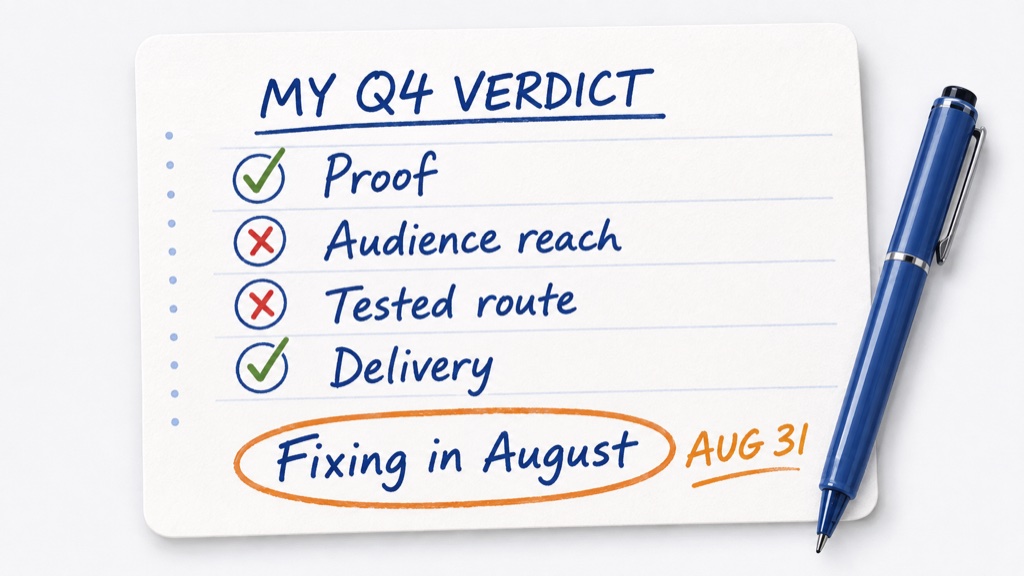
Open a note on your phone and fill this in.
- My Q4 hero offer is: ___
- Has it ever produced a sale? yes / no (if no, stop here and validate the offer before anything else)
- Proof: pass / fail
- Audience reach: pass / fail
- Tested traffic route: pass / fail
- Delivery or offer readiness: pass / fail
- The one thing I’m fixing in August: ___
Then put a date on that last line and add it to your calendar.
“But What If…”
“What if I fail all four?”
Then you have an order to work in, which is more than you had twenty minutes ago. Start with delivery if it’s a hard stop, otherwise start with proof.
“What if I don’t sell physical products?”
Every check has a version for you. Proof becomes the evidence in your own content, and Check 4 becomes offer readiness rather than shipping dates. Only the supplier math doesn’t translate.
“What if I’m starting from nothing and there’s no Q4 to save?”
Run the audit as a build order rather than a rescue. You probably won’t win Black Friday weekend from a standing start, but the same four things put you in decent shape for the December gap and the January reset, and both are far less crowded.
Twenty minutes won’t tell you whether your offer is a good one. It tells you whether the offer you’ve already got is ready to be put in front of buyers, which is a different question and, this close to the season, a more useful one.
There are 112 days left. That’s enough time to fix one thing properly, and nowhere near enough to fix everything, so use the priority rule above and start this week while it’s still cheap to get wrong.

